Monday, March 9, 2015


Famous people in the world of cinema. This week…

              Walt Disney and Charles Chaplin!! 


WALT DISNEY


Walt Disney was an America motion-picture and television producer. He was famous as a pioneer of cartoon films and as the creator of Disneyland.

QUICK FACTS
NAME
Walt Disney
OCCUPATION
 Producer
BIRTH DATE
 December 5, 1901
DEATH DATE
December 15, 1966
EDUCATION
 Kansas City Art Institute and School of Design, Mcklinley High School, Chicago Art Institute
PLACE OF BIRTH
Chicago, Illinois
PLACE OF DEATH
 Burbank, California
AKA
Walt Disney
FULL NAME
Walter Elias Disney


Walter Elias Disney was born on December 5, 1901. He and his brother Roy co-founded Walt Disney Productions, which became one of the best-known motion-picture production companies in the world. Disney was the creator of  the cartoon character Mickey Mouse. He won 22 Academy Awards during his life, and was the founder of theme parks Disneyland and  Disney World.
His brother Roy got him a job at the Pesmen-Rubin Art Studio, where he met the cartoonist  Ub Iwerks. Disney worked at the Kansas City Film Ad Company, where he made commercials based on  animation. Around this time, Disney began experimenting with a camera, doing hand-drawn animation, and he decided to open his own animation business. From the company.
Walt made a deal with a local Kansas City theater to screen their cartoons, which they called Laugh-O-Grams. The cartoons were very popular and Disney was able to acquire his own studio, upon which he bestowed the same name. Laugh-O-Gram hired a number of employees. They did a series of seven-minute fairy tales that combined  live action and animation, which they called Alice in Cartoonland.
Disney and his brother, Roy, soon joined their money and moved to Hollywood and to began the Disney Brothers' Studio. Their first deal was with New York distributor Margaret Winkler, to distribute their Alice cartoons. They also invented a character called Oswald the Lucky Rabbit.
In 1925, Disney toke on an  artist named Lillian Bounds and the couple married.
Mickey Mouse

He decided to produce three cartoons featuring a new character Walt had been developing called Mickey Mouse. The first animated shorts of Mickey were Plane Crazy, a silent film for which they failed to find distribution. When sound made its way into film, Disney created a third, sound-and-music-equipped short called Steamboat Willie. With Walt as the voice of Mickey, the cartoon was an instant sensation. 


In 1929, Disney created Silly Symphonies, which featured Mickey's newly created friends, including Minnie Mouse, Donald Duck, Goofy and Pluto. One of the most popular cartoons, Flowers and Trees, was the first to be produced in color and to win an Oscar. In 1933, The Three Little Pigs and its title song "Who's Afraid of the Big Bad Wolf?" became a theme.
Disneyland Park opened in the summer of 1955. It became known as a place where children and their families could explore, take rides and meet the Disney characters. 

Disneyland


In a very short time, the park had increased its investment and was entertaining tourists from around the world. With the original site having some attendance ups and downs over the years, Disneyland has expanded its rides over time and branched out globally with parks in Tokyo, Paris and Hong Kong, with a Shanghai location slated to open in December 2015.


Within a few years of the opening, Disney began plans for a new theme park and Experimental Prototype Community of Tomorrow in Florida. It was still under construction when, in 1966, Disney was diagnosed with lung cancer. He died on December 15, 1966, at the age of 65. After his brother's death, Roy carried on the plans to finish the Florida theme park, which opened in 1971 under the name Walt Disney World.


CHARLES CHAPLIN


He was born on April 16, 1889, in London, England. Charlie Chaplin worked with a children's dance troupe before making his mark on the big screen. His character "The Tramp" relied on pantomime and quirky movements to become an iconic figure of the silent-film era. Chaplin went on to become a director, making films such as City Lights and Modern Times, and co-founded the United Artists Corporation. He died in Corsier-sur-Vevey, Vaud, Switzerland, on December 25, 1977.

Beginning of his career  
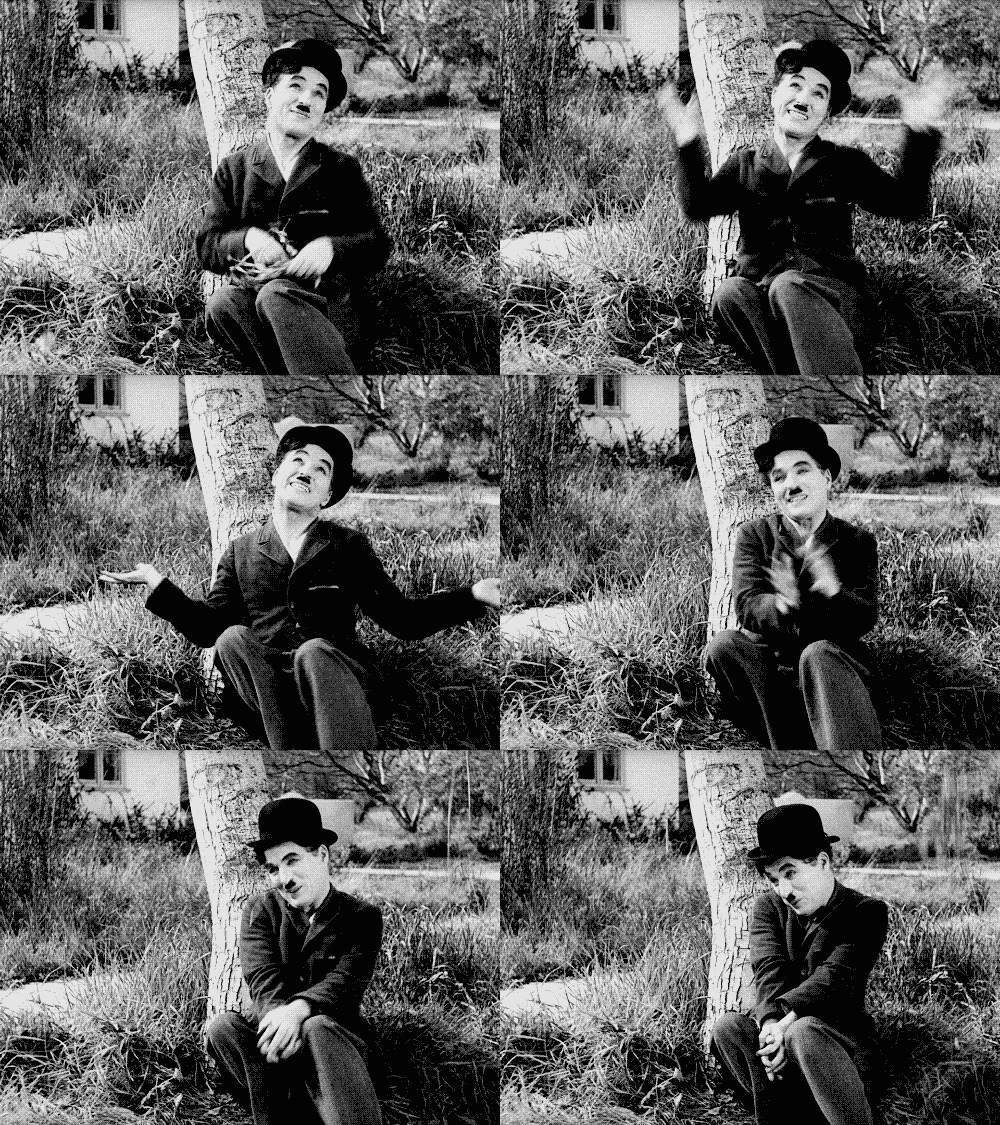

When he was about twelve, he got his first chance to act in a legitimate stage show, and appeared as
"Billy" the page boy, in support of William Gillette in "Sherlock Holmes". At the close of this engagement, Charlie started a career as a comedian in vaudeville, which eventually took him to the United States in 1910 as a featured player with the Fred Karno Repertoire Company.

Film Career
In 1914 Chaplin made his film debut in a somewhat forgettable one-reeler called Make a Living. To differentiate himself from the clad of other actors in Sennett films, Chaplin decided to play a single identifiable character, and "The Little Tramp" was born, with audiences getting their first taste of him inKid Auto Races at Venice (1914).
Over the next year, Chaplin appeared in 35 movies. During his first year with the company, Chaplin made 14 films, including The Tramp (1915). Generally regarded as the actor's first classic, the story establishes Chaplin's character as the unexpected hero when he saves the farmer's daughter from a gang of robbers.
By the age of 26, Chaplin, just three years removed from his vaudeville days, was a superstar. He'd moved over to the Mutual Company, which paid him a whopping $670,000 a year. The money made Chaplin a wealthy man, but it didn't seem to derail his artistic drive. With Mutual, he made some of his best work, including One A.M. (1916), The Rink (1916), The Vagabond (1916) andEasy Street (1917).
Through his work, Chaplin came to be known as a grueling perfectionist.
But the results were hard to refute. During the 1920s Chaplin's career blossomed even more. During the decade he made some landmark films, including:
 The Kid (1921)
The Pilgrim (1923)
A Woman in Paris (1923)
The Gold Rush (1925)
The Circus (1928).

Final Years
Nearing the end of his life, Chaplin did make one last visit to the United States in 1972, when he was given an honorary Academy Award. The trip came just five years after Chaplin's final film, A Countess from Hong Kong (1967), the filmmaker's first and only color movie. Despite a cast that included Sophia Loren and Marlon Brando, the film did poorly at the box office. In 1975, Chaplin received further recognition when he was knighted by Queen Elizabeth. In the early morning hours of December 25, 1977, Charlie Chaplin died at his home in Corsier-sur-Vevey, Vaud, Switzerland. His wife, Oona, and seven of his children were at his bedside at the time of his passing. In a twist that might very well have come out of one of his films, Chaplin's body was stolen not long after he was buried from his grave near Lake Geneva in Switzerland by two men who demanded $400,000 for its return. The men were arrested and Chaplin's body was recovered 11 weeks later.
Bibliography:
http://www.biography.com/people/walt-disney-9275533#disneyland
http://www.anb.org/articles/18/18-00309.html
http://www.biography.com/people/charlie-chaplin-9244327
http://www.charliechaplin.com/en/biography/articles/21-Overview-of-His-Life


Thursday, March 5, 2015

NOMINEES AND WINNERS OSCAR 2015

Did you watch the ceremony? If not, here it is:


LIST OF WINNERS:
Best supporting actor: JK Simmons for Whiplash
Best supporting actress: Patricia Arquette for Boyhood
Best foreign-language film: Ida – Paweł Pawlikowski
Best director: Alejandro González Iñárritu for Birdman
Best actor: Eddie Redmayne for The Theory of Everything
Best actress: Julianne Moore for Still Alice
Best picture: Birdman
Achievement in costume design: The Grand Budapest Hotel – Milena Canonero
Achievement in makeup and hairstyling: The Grand Budapest Hotel – Frances Hannon, Mark Coulier
Best documentary short subject: Crisis Hotline: Veterans Press 1 – Ellen Goosenberg Kent, Dana Perry
Achievement in sound mixing: Whiplash – Craig Mann, Ben Wilkins, Thomas Curley
Achievement in sound editing: American Sniper – Alan Robert Murray, Bub Asman
Achievement in visual effects: Interstellar – Paul J Franklin, Andrew Lockley, Ian Hunter, Scott R Fisher
Best animated short film: Feast – Patrick Osborne, Kristina Reed
Best animated feature film: Big Hero 6
Best production design: The Grand Budapest Hotel: Adam Stockhausen, Anna Pinnock
Achievement in cinematography: Birdman: Emmanuel Lubezki
Best original song: Glory from Selma – Lonnie Lynn (Common), John Stephens (John Legend)
Original screenplay: Alejandro González Iñárritu, Nicolás Giacobone, Alexander Dinelaris, Armando Bo – Birdman


Where? The 87th Academy Awards took place on Sunday 22nd February in Los Angeles. The ceremony began at 8:30pm (1:30am in Europe)

Who did host the ceremony? The star Neil Patrick Harris (Gone Girl and How I Met your Mother) hosted the Oscars for the first time.  Harris kicked off the proceedings on an edgy note, saying it was a night to celebrate "Hollywood's best and whitest - sorry, brightest" - a cutting reference to this year's total lack of non-white acting nominees.


But the reaction on Twitter to his efforts has been mainly negative; Journalist Tina Brown (from The Daily Beast y Newsweek) called him "smirking" and "clueless", while Empire Magazine's Chris Hewitt said: "As star of How I Met Your Mother, Neil Patrick Harris has form with unfunny formats being stretched out beyond their natural finishing line."


YOU HAVE TO KNOW...


Best Picture: Birdman

Director: Alejandro Gonzalez Inarritu

Cast includes: Michael Keaton, Emma Stone, Edward Norton, Naomi Watts, Lindsay Duncan, Andrea Riseborough

What's the story? In this black comedy, former movie superhero actor Riggan Thomson (Keaton) hopes to revive his washed up career by putting on Broadway play.

Fact: Using some clever camerawork, the film looks as though it was shot in a single take.

What the critics say: "The director's surrealist portrait of modern times and the cult of celebrity is brilliant on so many levels that even the occasional downdraft can't keep Birdman from soaring." Betsey Sharkey, LA Times


Who are them?


Alejandro González Iñárritu (born August 15, 1963) is a Mexican film director, screenwriter, film producer, and composer. His five feature films – Amores perros (2000), 21 Grams (2003), Babel (2006), Biutiful (2010) and Birdman (2014) – have gained critical acclaim worldwide and have received multiple Academy Award nominations. He won three Academy Awards in 2015 for Best Director, Best Original Screenplay, and Best Picture for Birdman.


The Mexican director dedicated his best picture win for “Birdman” to his fellow Mexicans, and called on his countrymen to “find and build a government that we deserve.”

Regarding Mexicans living in the United States, he was more forceful: “I just pray they can be treated with the same dignity and respect of the ones that came before and built this incredible, immigrant nation.''


Eddie Redmayne: (born 6 January 1982) is an English actor, singer and model. He started his professional career as an actor in both theatre and television roles in the early 2000s and then made his film debut, Like Minds, in 2006.
He has since appeared in such prominent films as The Good Shepherd (2006), Elizabeth: The Golden Age (2007), My Week with Marilyn (2011), Les Misérables (2012), The Theory of Everything (2014), and Jupiter Ascending (2014). Redmayne received universal critical acclaim for his performance as Stephen Hawking in The Theory of Everything, for which he has won the Academy Award for Best Actor, the Golden Globe Award, the Screen Actors Guild Award and the BAFTA Award. He has also continued to perform in theatre, most notably in the play Red (2010), on Broadway, for which he won the Tony Award for Best Performance by a Featured Actor in a Play.

He attended Colet Court then Eton College, where he was in the same year as Prince William, Tom Hiddleston and Ivo Stourton. He went on to study history of art at Trinity College, Cambridge, from where he graduated with 2:1 Honours in 2003.


Julianne Moore is an American-British actress and children's author. Prolific in cinema since the early 1990s, Moore is particularly known for her portrayals of emotionally troubled women. Her career has involved both art house and Hollywood films.
Moore received considerable recognition in the late 1990s and early 2000s, earning Oscar nominations for Boogie Nights (1997), The End of the Affair (1999), Far from Heaven (2002), and The Hours (2002). Other notable film appearances include The Big Lebowski (1998), Magnolia (1999), Hannibal (2001), Children of Men (2006) and A Single Man (2009). She continued to work regularly in the 2010s, appearing in the popular Hunger Games series and receiving praise for her performances in The Kids Are All Right (2010), Maps to the Stars (2014), and Still Alice (2014), for which she has won the Academy Award, Golden Globe Award, Screen Actors Guild Award and BAFTA Award for Best Actress. In the television film Game Change (2012), she portrayed Sarah Palin and received the Emmy Award, Golden Globe Award, and Screen Actors Guild Award for Best Actress.
In addition to acting, Moore has written a successful series of children's books. She is married to the director Bart Freundlich, with whom she has two children.

BIBLIOGRAPHY:

http://www.latimes.com/local/lanow/la-me-ln-irritu-oscar-speech-20150222-htmlstory.html
http://www.bbc.com/news/entertainment-arts-30681208
http://oscar.go.com/
http://www.independent.co.uk/arts-entertainment/films/oscars/oscars-2015-what-date-do-the-awards-take-place-and-how-can-you-watch-them-in-the-uk-10042201.html
http://web.orange.co.uk/article/news/neil_patrick_harris_nervous_and_boring
http://en.wikipedia.org/wiki/Julianne_Moore
http://en.wikipedia.org/wiki/Eddie_Redmayne
http://es.wikipedia.org/wiki/Alejandro_Gonzalez_Inarritu
http://www.telegraph.co.uk/culture/film/oscars/11419924/oscars-2015-live.html
http://www.smh.com.au/entertainment/oscars/oscars-2015-live-winners-and-highlights-of-the-87th-academy-awards-ceremony-20150223-3qrby.html


Sunday, March 1, 2015

OSCARS... WHAT ABOUT THEIR HISTORY?


The history of the Oscars begins on May 16, 1929. It was officially known as the Academy of Motion Picture Arts and Sciences Awards. The award ceremony was originally an attempt to help Hollywood improve its tawdry image, but it has grown to become the highest critical honor for cinematic professionals, in addition to one of the biggest public events on the Hollywood calendar.


The First Oscar Ceremony: 
The first Oscar award ceremony was held at the Hollywood Roosevelt Hotel in 1929. The first Academy president was the actor Douglas Fairbanks, who found himself very busy over the course of the ceremony, as he was handing out the statuettes by himself.

In contrast to the secrecy surrounding contemporary Oscar ceremonies, the first ceremony held no suspense, as the winners had been announced three months earlier. The statuettes were handed out quickly because most of the nominees and winners didn't go to the event.

Emil Jennings
The first of the 15 total statuettes handed out was received by the German actor Emil Jennings. He had plans to leave the country before the ceremony, and that is why he received his award early. This makes him the first person to ever receive an Oscar.


Janet Gaynor became the first woman winner of the Academy Award for best actress for her performance in three films: 7th HeavenSunrise: A song of two Humans and Street Angel. This was the only occasion on which an actress has won one Oscar for multiple film roles. 


Janet Gaynor


Evolution of the Oscars: 
The first Oscar award ceremony was the only one not to be broadcast publically. By the second year, the ceremony was being broadcast on radio. In 1953, the ceremony was broadcast on TV for the first time. In 1969 the broadcast went worldwide.


From 1929 to 1940, newspapers received the list of Oscar winners before the ceremony. This arrangement was done so the papers could publish the list in the evening edition, right after the award ceremony finished. 


The arrangement work well enough until 1940, when the Los Angeles Times published the winners early-before the actual ceremony. The Academy implemented a sealed-envelope method the following year, an approach that has worked so well that has been used ever since.


Evolution of the Oscar Statuette:

Margaret Herrick
The term "Oscar"came about by accident. It is used to refer to the little statuettes received by winners. It is believed that the academy librarian Margaret Herrick made an innocent comment that the little statue, which was named the Academy Award of Merit, looked like her uncle Oscar. The nickname stuck and it is now the general term most people use to refer to both the Academy of Motion Picture Arts and Science Awards and the actual awards ceremony. 


The actual Oscar award is 13 1/2 inches tall (34,3 cm). The very first Oscars were created from solid bronze. During the World War II, Oscars were made of plaster to help conserve resources. Nowadays, the statuette is gold plated and heavy, weighing in at about 8 pounds (3,6 kg).


The Oscar Academy:
The people who decide on the nominations and winners of the Oscars are known as the Academy of Motion Picture Arts and Sciences. The original academy had only 36 members. Currently, the academy boasts around 6,000 members. 

Academy membership is limited to film artists working in the production of theatrically-released motion pictures. The Academy’s membership process is by sponsorship, not application.  Candidates must be sponsored by two Academy members from the branch to which the candidate seeks admission. In addition, Academy Award nominees are automatically considered for membership and do not require sponsors. 
Membership review takes place once a year, in the spring.
The Academy has 17 branches, for the crafts ranging from Actors to Writers, and two categories, Members-at-Large and Associates to accommodate individuals who work in motion picture production but do not fit into one of the branches.


THE ORIGIN OF OSCAR


BIBLIOGRAPHY: 
Oscars Ceremonies:  http://www.oscars.org/oscars/ceremonies/1929 [Access 20/02/2015]
The Oscars: http://oscar.go.com [Access 20/02/2015]
Oscars: http://www.oscars.org/ [Access 20/02/2015]
YouTube: https://www.youtube.com/watch?v=_thW3N98cFQ [Access 27/02/2015]

Friday, February 20, 2015

BREAKING NEWS!


BREAKING NEWS!!

Plastic Jesus battles Hollywood and drugs with a coke-snorting Oscar
Do yo remember the golden Oscar statue with a heroine needle in its arms last year? Plastic Jesus was the creator. He is a street artist from Los Angeles and this year, just a couple of days before the stars hit the red carpet at the Oscars on Sunday, he had erected a life-size golden statue on Hollywood Blvd. This statue is bent over on the ground and snorting giant lines of cocaine with a straw and credit card.
plastic-jesus.pngOscars, Rogue Statue
 "The piece is intended to draw attention to Hollywood's hidden problem of drug addiction that effects hundreds of people in the showbiz industry and is largely ignored until the death of a high profile A list celebrity," photographer Nick Stern, who works with Plastic Jesus, explained.

Wednesday, February 18, 2015

HOLLYWOOD WALK OF FAME

WALKING ON THE HALL OF FAME…

The Hollywood Walk of Fame is an internationally-recognized Hollywood icon. It has become a visitor attraction and one of the most successful marketing ideas ever produced.


E.M. Stuart was a volunteer president of the Hollywood Chamber of Commerce. He had the idea of creating a Walk of Fame in 1953. He proposed it to “maintain the glory of a community whose name means glamour and excitement in the four corners of the world”. The main precursor of this idea was the ceiling of the dining room of the historic Hollywood Hotel. In this hotel, stars with the name of celebrities were painted on the ceiling. However, it was used as a proposal to place stars in the sidewalks.


In 1955, the Hollywood Chamber of Commerce proceeded to secure signatures to present to the City for further action in the formation of an assessment district. This idea was embraced by the Los Angeles City Council.


In February of 1956, it was proposed a star that included a caricature of the honoree, with a proposal for brown and blue sidewalks. The Hollywood businessman C.E. Toberman nixed the idea.

The Hollywood Improvement Association was established by the Chamber in order to work with the City in pursuing the idea. Harry Sugarman was selected to do it. Moreover, there were four committees to represent the four different aspects of the entertainment industry at that time: motion picture, television, recording and radio. Members of the Motion Picture Selection Committee included prominent names such as Cecil B. DeMille, Samuel Goldwyn, Jesse Lasky, Walt Disney, Hal Roach, Mack Sennett and Walter Lantz, among others.

The selection process was criticized. One of those whose name was not approved for inclusion in the initial phase of the Walk of Fame was Charlie Chaplin. The Chamber published a press release in 1961 which was addressed the controversies over the selection process: “The names in the Walk of Fame have been subject to the most continuous criticism and abuse. These are divided into two classes: those who think the wrong names are included and those who think their own or some favorite’s name was omitted.”

The cost to build the Walk, including new street lighting and street trees, was determined to be $1.25-million.

On August 15, 1958, the Chamber and City unveiled eight stars on Hollywood Blvd at Highland Avenue to demonstrate what the Walk would look like. The eight honourees included: Olive Borden, Ronald Colman, Louise Fazenda, Preston Foster, Burt Lancaster, Edward Sedgwick, Ernest Torrence, and Joanne Woodward.

On February 8, 1960, construction actually began on the long-planned Walk. The first star was that of Stanley Kramer on March 28, 1960. The job was completed in spring 1961, when it was finally accepted by the Board of Public Works, with the first 1,558 stars.

The Chamber faced three task in moving forward, in order to add more names in the vacant stars:
1.      To stablish a set of rules to determine the qualifications of personalities to be eligible for addition to the Walk of Fame
2.       To work out a procedure to process candidates
3.       To develop a plan for the financing of the costs of the addition of approved names.
This task took several years and in December 1968, another star was added.


Today, the Hollywood Chamber of Commerce continues to add stars to the Walk of Fame as the representative of the City of Los Angeles. An average of two stars are added to the Walk on a monthly basis. The last ceremony was on February 2, 2015. The Hollywood Walk of Fame recipients for the year 2015 are:

MOTION PICTURES:
Raymond Chandler (posthumous), Eugenio Derbez, Will Ferrell, Jennifer Garner, Peter Jackson, Bob Kane (posthumous), Daniel Radcliffe, Paul Rudd, Snoopy, Melissa McCarthy and Christoph Waltz


TELEVISION:
James L. Brooks, Ken Ehrlich, Bobby Flay, Seth MacFarlane, Julianna Margulies, Chris O’Donnell, Jim Parsons, Amy Poehler, Kelly Ripa and Sofia Vergara.

RECORDING:
Lukasz ‘Dr. Luke’ Gottwald, Kool & The Gang, Pitbull, Al Schmitt and Pharrell Williams.

RADIO:
Larry Elder.

LIVE THEATRE/LIVE PERFORMANCE:
Kristin Chenoweth, Dick Gregory and Ennio Morricone.


NOMINATION PROCESS TO GET A STAR ON THE WALK OF FAME

You can be nominated.
Someone (fans, manager, and a familiar) can put forward as a candidate.  Nominations applications must be sent to Hollywood Walk of Fame Committee. However, the candidate must accept his candidacy.


There are some requirements in order to be a candidate:

- The application letter has to be signed by the candidate.
-  It must be sent before May 30th.

 The applicant must pay 30,000 dollars.
         

The candidate:

 1. Must have worked in the entertainment industry at least for five     years.
 2. Must hold the record.
 3. Must stand out (in television, cinema, radio, music or theatre).
 4.  Must contribute with money towards charities.

There is an exception: posthumous mentions. Five years must have passed since their death.


THE PROCESS OF SELECTION
The list of candidates is formed by 20 nominations and a tribute to a posthumous. Finally, the selected has to go to Hollywood in order to make a celebration in honour of the star. If the chosen do not go within five years, she/he will lose the star.

THE EMBLEMS WHICH INDICATE THE CATEGORY OF THE HONOREE’S CONTRIBUTIONS


1.       Classic film camera representing motion pictures


2.       Television receiver representing broadcast television


3.       Radio microphone representing broadcast radio


4.       Phonograph record representing audio recording or music


EXCEPTIONS: PEOPLE WHO HAVE DIFFERENT STARS
-          The Apollo 11 astronauts for contributions to the television industry
-          The sportsman Magic Johnson for his theatre chain (Magic Johnson Theatre)
-          Fictional characters, for example: Mickey Mouse
-          The former Mayor of Los Angeles, Tom Bradley
-          The police force of Los Angeles
-          The lingerie brand Victoria’s Secret
-          The baseball team Dodgers.


SOME CURIOSITIES ABOUT WALK OF FAME…
- Four stars have been stolen from Walk of Fame: James Stewart, Kirk Douglas, Gregory Peck, and Gene Autry.
-  Since 1960, 40 famous have rejected their star. Some of them are: Julia Roberts, George Cooney, and Clint Eastwood.
-  Barbara Streisand is the only person who has received a star without attending her ceremony
-   Muhammad Ali’s star is the only one which is not on the floor.

-          Some names are duplicated. For example: Harrison Ford.
-          Ronald Reagan is the only president who are a star.
-          There are some famous who are several stars: For example: Michael Jackson.

BIBLIOGRAPHY:
Walk of Fame: http://www.walkoffame.com/ [Access 11/02/2015]
History of the Walk of Fame: http://www.walkoffame.com/pages/history [Access 11/02/2015]
Official Hollywood Walk of Fame : http://www.hollywoodchamber.net/ [Access 11/02/2015]